
Solar Water Pumps
A solar water pump is a system that uses electricity generated by solar panels to power a water pump, providing an eco-friendly and cost-effective solution for various applications like agricultural irrigation, domestic water supply, and livestock watering. They are particularly useful in remote areas without reliable grid electricity. The main difference between a solar pump and an electric pump is their source of power. An electric pump relies on grid electricity to operate, while a solar pump uses energy from the sun to power its motor and pump. This makes solar pumps more environmentally friendly and cost-effective in off-grid or remote locations. Solar water pumps use solar energy converted into electricity by photovoltaic (PV) panels to power an electric motor that draws water from a source. They are a cost-effective, eco-friendly alternative to traditional diesel or grid-powered pumps, especially in remote areas for agricultural, livestock, and domestic water needs
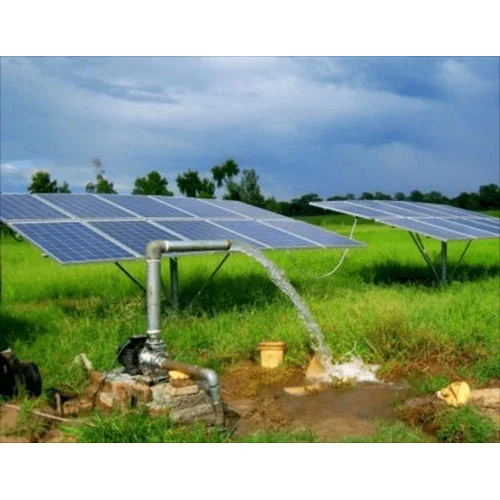
A typical solar water pumping system consists of several main parts:
Solar Panels (PV Array): These capture sunlight and convert it into DC electricity. They are typically the most expensive component of the system.
Motor Pump Set: The electric motor runs the pump mechanism (impeller/piston) to draw water. Motors can be AC or DC, with AC pumps requiring an inverter.
Pump Controller / Variable Frequency Drive (VFD): This device manages the power flow, ensures the pump operates efficiently, and protects it from electrical issues like dry runs, over-voltage, or low voltage. A VFD is used for AC pumps to convert the DC power from the panels to AC power.
Piping and Water Storage: Pipes transport the water to its destination, often a storage tank, which effectively acts as an energy storage system (storing water for use when the sun isn’t shining).
How It Works
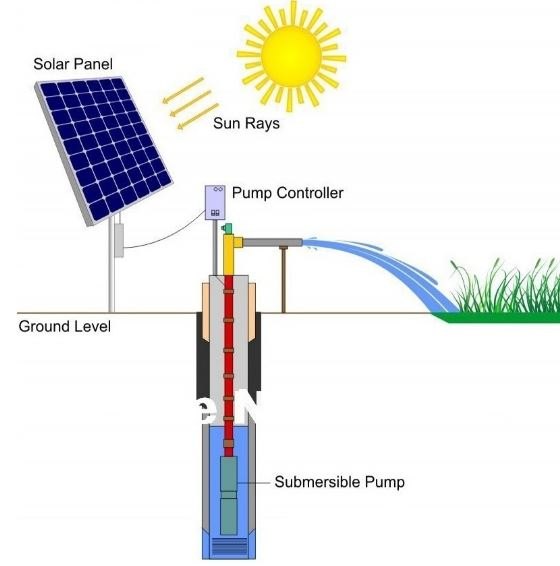
Solar-powered water pumping system operates on electricity generated by solar cells or photovoltaic (PV) cells in solar panels. When exposed to sunlight, these solar PV panels transform solar energy into direct current (DC) electricity. The DC power flows into a control box which manages the electricity, which is utilized to operate motor pump sets. The control box also protects the motor for voltage fluctuations.
1. The water pumping system then draws water from other water bodies like pond, canal, open well, bore well to irrigate fields.
2. Most solar water pumps run directly off solar panels (PV direct) and do not require batteries. Using batteries may complicate an otherwise straight forward application. Instead of storing electricity in batteries, it is preferred to store water in a holding tank.
3. Linear current boosters for Solar Pumps (LCBs) allow the pump motor to run longer during the day by translating additional voltage to necessary current during periods of low sun.
Key Components
Sunlight Hits Solar Panels: Photovoltaic (PV) panels absorb photons from sunlight, which generates direct current (DC) electricity.
Electricity Powers the Motor: The DC electricity is sent to a controller. If the system uses an AC motor, the controller uses an inverter to convert the DC power to AC power.
Pump Draws Water: The electric motor drives the pump mechanism (either a surface or submersible pump), which draws water from a source like a well, pond, river, or bore well.
Water is Delivered: The extracted water is transported through a piping system to its end destination, such as an irrigation field or a storage tank.
How Much Subsidy Do Farmers Get For Installing Solar Pumps?
The Component B of the PM-KUSUM (Pradhan Mantri Kisan Urja Suraksha Evam Utthaan Mahabhiyan) Yojana offers farmers a subsidy for installing off-grid solar water pumps in India.
Financial support offered by the central government: The government will pay 30% of the total solar water pump price (whichever is lower: the standard cost or tender cost).
Higher subsidy for certain areas: If you’re in the North East, hilly areas, Union Territories, or islands, you will get a 50% subsidy instead of 30%.
Component B of the PM-KUSUM Yojana has been designed to help farmers get affordable solar water pumps with government support so they don’t have to depend on diesel or grid electricity. Through this scheme, the government aims to install 14 lakh standalone solar pumps.
You can benefit from this subsidy scheme if you’re one of the following people or groups:
Individual farmers
A group of farmers
Water User Associations (WUA)
Farmer Producer Organizations (FPO)
Primary Agriculture Credit Societies (PACS)
Anyone involved in cluster-based irrigation systems
What is The Solar Pump Price in India in 2025?
Solar pump prices in India vary significantly based on the manufacturer, the motor capacity, and the type of pump in question.
The price can range from ~Rs. 70,000* for a 1 HP pump to ~Rs. 7,30,000* for a 10 HP pump.
Here’s a rate list based on standard market estimates:
Power Rating of the Solar Motor Pump in Horsepower (HP)
Solar Water Pump Price in India in 2025*
1 HP ~Rs. 70,000 to ~ Rs. 89,000
2 HP ~Rs. 1,60,000 to ~ Rs. 1,75,000
3 HP ~Rs. 1,30,000 to ~ Rs 2,40,000
5 HP ~Rs. 2,00,000 to ~ Rs 3,50,000
10 HP ~Rs. 4,50,000 to ~ Rs 7,30,000
*Please note: The solar water pump prices mentioned in the section above are indicative estimates based on publicly available market data as of 2025. Actual solar water pump prices can vary significantly based on the brand or manufacturer, motor type (AC or DC), power rating (HP), installation location (surface or submersible), system design, and applicable government subsidies under schemes like PM-KUSUM Yojana. These rates are intended for general informational purposes only and should not be treated as an official quotation or offer. SolarSquare does not manufacture, sell, or install solar water pumps. We do not earn commission or revenue from any pump vendors, nor do we endorse any specific brand.
Our Projects
Our work in numbers
employees
70
happy clients
156
years of experience
25+
offices worldwide
2
Testimonials
Lorem ipsum dolor sit amet, at mei dolore tritani repudiandae. In his nemore temporibus vim ad prima vivendum.
Jane Doe

Lorem ipsum dolor sit amet, at mei dolore tritani repudiandae. In his nemore temporibus vim ad prima vivendum.
John Denver

Lorem ipsum dolor sit amet, at mei dolore tritani repudiandae. In his nemore temporibus vim ad prima vivendum.
Michelle Smith

Contact us
Avi Buildtech is a leading solar energy business solutions provider offering extensive clean energy solutions and consultancy services for setting up on-site (rooftop and ground mounted), off-site, domestic, institutional and commercial solar projects